
Relationships
Hardware, software, user flow, integrations, ownership, and operations, tied together before the first line of code.
Founder profile
My strength is connecting idea, system, and practical implementation: from an unclear task to a first version that can be tested and used right away.
Read the full technical profile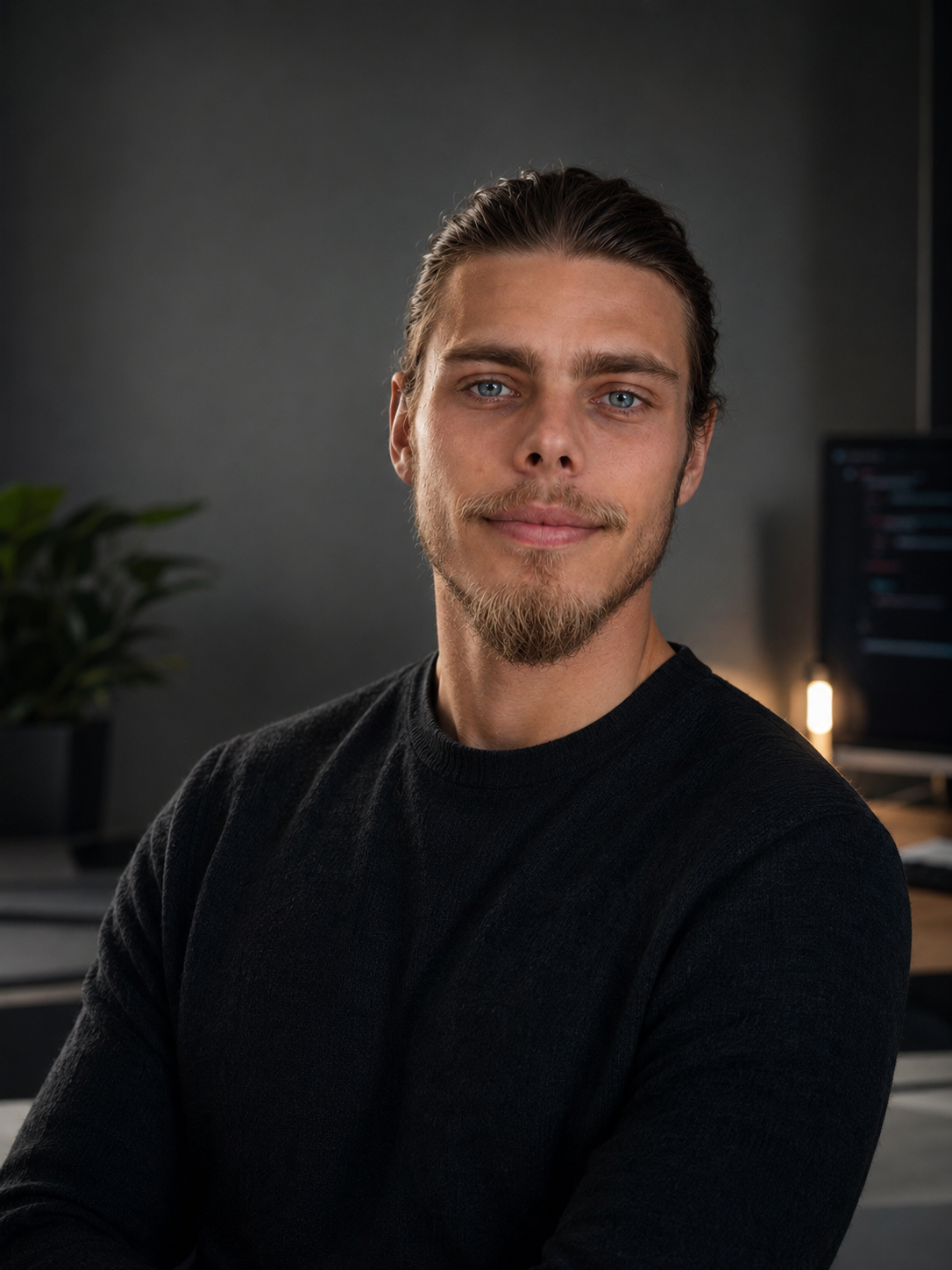
Thinking model
Process, interface, data, machine, and failure modes. Map first, then build.
Hardware, software, user flow, integrations, ownership, and operations, tied together before the first line of code.
Small builds, real feedback, fewer assumptions, and quick restructuring along the way.
Codex, Claude, ChatGPT, prompting, and review loops, with human direction the whole way.
Modularity, orchestration, documentation, maintenance, and room for the next iteration.
Position
My stance on AI isn't that it should be avoided. It's about where it lives, who owns it, and what it costs to run.
Most of the industry builds AI as a call to somebody else's server. That's fast to get started with, but it makes the product dependent on an API key, a price that can change, and a logging policy you didn't write yourself. I build it the other way around: the model should run locally wherever possible, on the machine that actually needs it, and the cloud becomes the exception instead of the default.
That's not a technical preference for its own sake. It's three things I take seriously whenever I build something for someone: who owns the result, where the data actually travels, and how much compute gets spent on a task that never needed it.
Ollama, local inference, and a clear line for when a task genuinely needs a cloud model, and when it doesn't.
Code, data, and decisions that can be inspected, exported, and changed, without depending on a subscription staying active.
The simplest privacy guarantee is still that data never leaves the machine. That's the starting point, not a feature you switch on.
A small local model for a small task isn't just cheaper. It's also a rejection of routing everything through a huge cloud model that was never proportional to the job.
Technical range
Stack isn't my identity. It's the tool that gets a system running.
TIA Portal, TwinCAT 3, OPC UA, sequence logic, PID, sensors, and fault handling.
ESP32, ESP32-S3, Raspberry Pi Pico, MicroPython, GPIO, displays, and motor drivers.
Frontend, static-first delivery, Node.js tooling, content systems, and deployment.
Codex, ChatGPT, Claude, Cursor, n8n, context management, and review loops.
Good fit
Scope, system sketch, prototype, release, and learning along the way, in that order.
Data routing, n8n, handoffs between people, automation, fewer manual steps.
Information architecture, systems UI, credible frontend, operational clarity.
Current
Best for
Contact
Send a short brief. Context matters more than polished writing.
Start dialogDeep dive
Overview for work where software, automation, AI, and physical systems knowledge meet.
PLC, Ladder, Function Blocks, TIA Portal, TwinCAT 3, OPC UA, SQL, IO, sensors, actuators, buffer logic, RFID, fault handling.
DENSO, WinCaps III, PACScript, palletizing, robot/PLC coordination, PID, Ziegler-Nichols, signal analysis, deterministic control.
ESP32, ESP32-S3, TTGO T-Display, Raspberry Pi Pico, MicroPython, GPIO, TFT, motor drivers, sensors, edge-device logic.
Codex, ChatGPT, Claude, Cursor, Ollama, OpenAI APIs, n8n, React, Node.js, prompting, context, review, deployment.
Information architecture, compact navigation, technical copy, high signal, and low visual noise.
Understand the system, build the version, test the constraints, remove friction, document the next iteration.